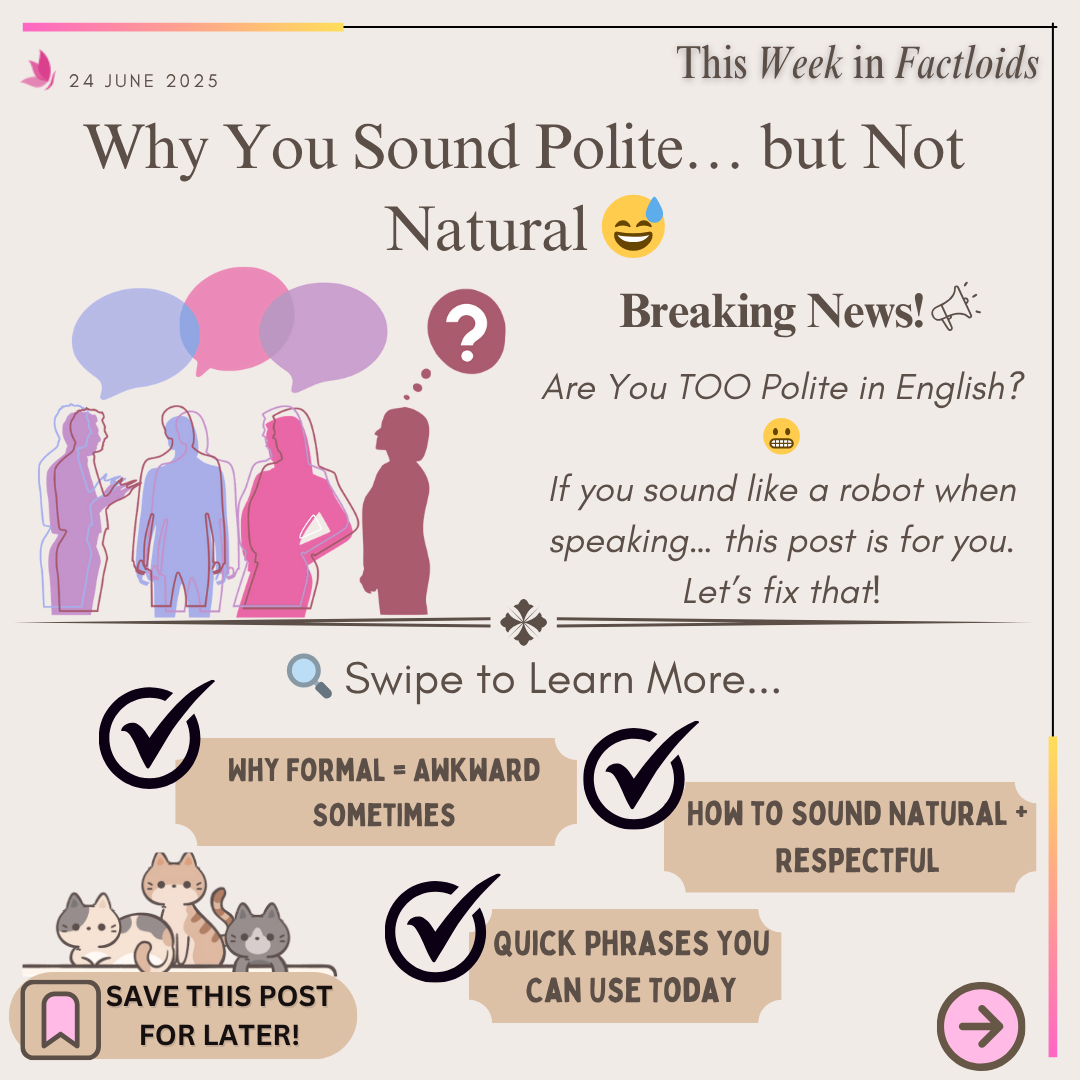
Are You Too Polite?
When learning English, many students start with phrases like:
“I would like to inquire about the position.”
Perfect grammar — but in real life, it can sound stiff, robotic, or even outdated.
This happens because textbook English doesn’t always match real-life conversation.
Today, we’re going to fix that.
🤖 The Textbook Trap: Why Formal Phrases Don’t Work in Real Life
Textbooks love long, polite sentences. But native speakers usually go for quick, natural ones.
Here’s what that looks like:
| Textbook English | Real English |
|---|---|
| It is required that I submit it. | I need to turn it in. |
| I would appreciate your response. | Let me know! |
| Would it be possible to meet today? | Can we meet today? |
| It is of great importance. | It’s really important. |
Overusing the formal versions can make you sound:
- Robotic 🤖
- Overly serious 🧑⚖️
- Or even awkward 🫣
🗣️ How to Sound Polite and Natural
The secret? It’s not about being less polite — it’s about using modern, relaxed expressions.
✅ Try These Instead:
| Situation | Formal Phrase | Natural Phrase |
|---|---|---|
| Asking for help | “I would like some help.” | “Can you help me out?” |
| Making a request | “Would you be so kind as to…” | “Could you…” / “Would you mind…” |
| Offering to help | “Shall I assist you?” | “Want me to help?” / “Need a hand?” |
| Starting a question | “May I ask…” | “Just wondering…” / “Quick question…” |
🧠 Pro tip: Native speakers almost always use contractions (I’m, I’ll, I’d) and casual phrasing unless they’re in a formal setting like an interview or speech.
📺 How to Train Your Ear (and Your Voice!)
Want to sound more natural?
Listen to how people really speak.
🔉 Try this:
- Watch shows like The Office, Brooklyn Nine-Nine, or Modern Family — listen to everyday English (More Recommendations here!)
- Copy phrases you hear out loud (this builds confidence + muscle memory)
- Record yourself using both versions: formal vs natural
- Ask: “Would I actually say this in real life?”
🎯 Real-World Challenge: Can You Rewrite These?
Let’s practice! Rewrite these formal sentences in a more natural, polite tone:
- I would like to book a room for two.
- It is necessary that we discuss the matter.
- May I inquire about the price of this item?
- I would appreciate it if you could respond.
- It is of utmost importance that I attend.
💬 Share your answers in the comments — or check out ours at the bottom of the post!
💡 Final Thought
Being polite in English doesn’t mean sounding like a textbook.
It means connecting — clearly, kindly, and naturally. ❤️
.
.
.
.
Since you’ve made it to the end, here’s a gift from us:
🎁 Grab the printable worksheet to test your natural English in real life!
Want more tips like this every week?
➡️Follow us on Instagram for fresh learning content you’ll actually use.


