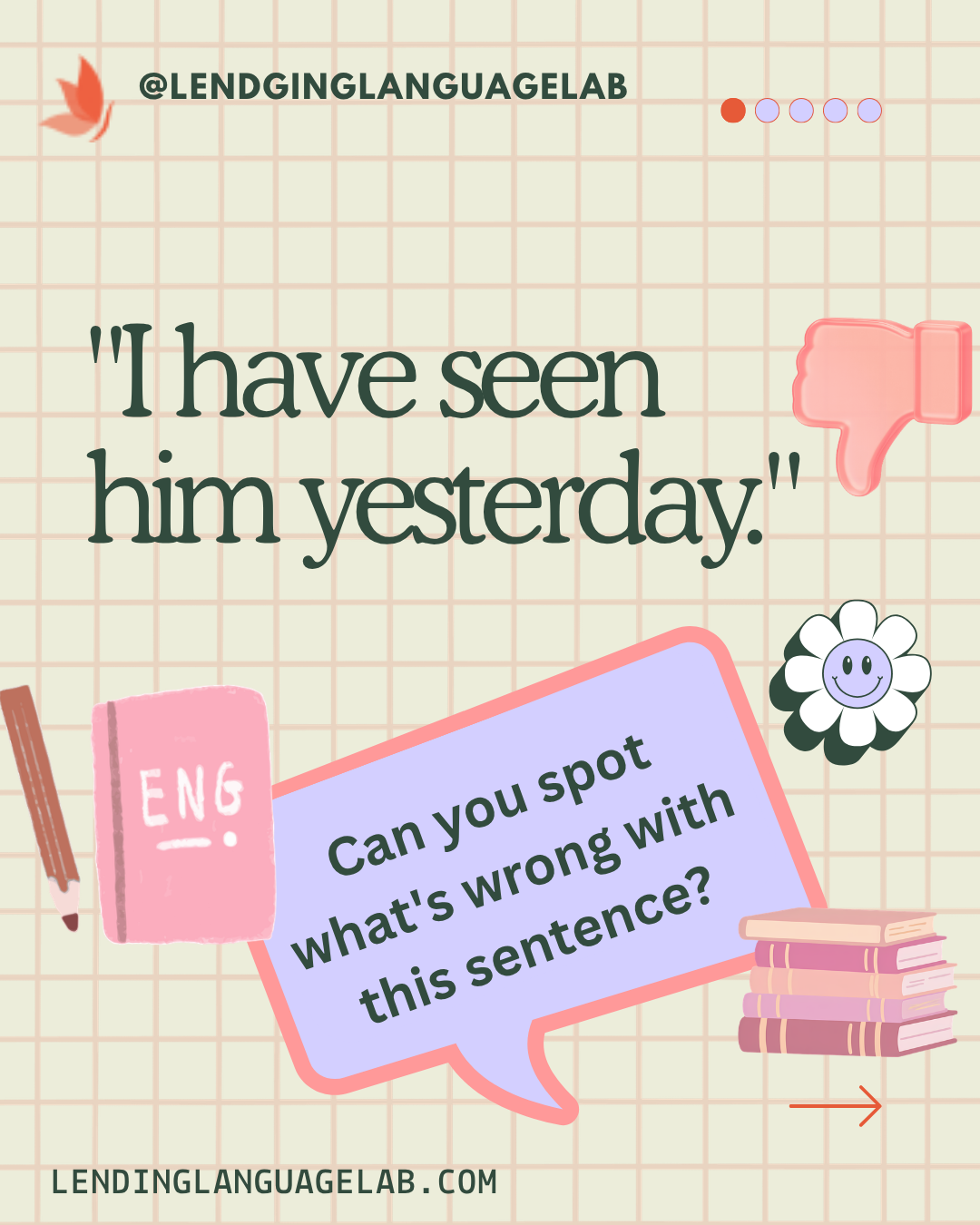
Mixing up the past simple and the present perfect happens to the best of us.
You’ve probably spent plenty of time racking your brain trying to figure out which one actually fits your sentence. Well, it’s not impossible to understand the rules of these tenses, but they serve two completely different purposes! The real trap is that your native language might not draw the line in the exact same spot, which means choosing between them feels like a guessing game. Your instincts give you zero help here, so your brain has to catch the difference by context every single time.
Let’s break them down properly so you never have to second-guess yourself again.
The Short Version
Past simple = a finished action at a specific point in the past. It’s done, it’s over, and usually you can point to when it happened.
Present perfect = a past action connected to the present. Either it’s still relevant right now, or you’re deliberately not saying exactly when it happened.
- I visited Paris in 2019. (Past simple ⪼ done, specific time, closed chapter.)
- I have visited Paris. (Present perfect ⪼ no specific time given, and the relevant point is simply that the experience happened.)
Same city, same action, completely different focus.
The Test That Actually Works
Ask yourself one question: does this sentence care about when, or does it care about whether?
If the answer is “when,” use past simple. If the answer is “whether it happened at all, or how it connects to now,” use present perfect.
For Example:
- She finished the report yesterday. → We care about when. Past simple.
- She has finished the report. → We care that it’s done, right now, period. Present perfect.
Signal Words (Your Built-in Clues)
Just a quick definition first: signal words are the specific words in a sentence that hint at which tense you need, almost like the sentence is giving you the answer before you even have to think about it. You don’t need to memorize grammar rules if you just learn to spot these.
Past simple loves specific time markers: yesterday, last week, in 2020, two hours ago, when I was a kid.
Present perfect loves the vague-but-relevant markers: already, yet, just, ever, never, since, for, so far.
Here’s the thing: these signal words practically do the work for you. If you see “yesterday” in a sentence, present perfect is off the table immediately, no exceptions.
Cheat Sheet: Signal Words At a Glance
| Past Simple | Present Perfect |
|---|---|
| yesterday | already |
| last week/month/year | yet |
| … ago (e.g., two hours ago) | just |
| in [year] (e.g., in 2020) | ever |
| when I was a kid | never |
| at [specific time] (e.g. at 6 PM) | since |
| that day | for |
| — | so far |
| — | up to now |
Save this table. When you’re stuck mid-sentence, just scan it; if your sentence has a word from the left column, use past simple; if it has one from the right, use present perfect.
The Mistake I See Constantly…
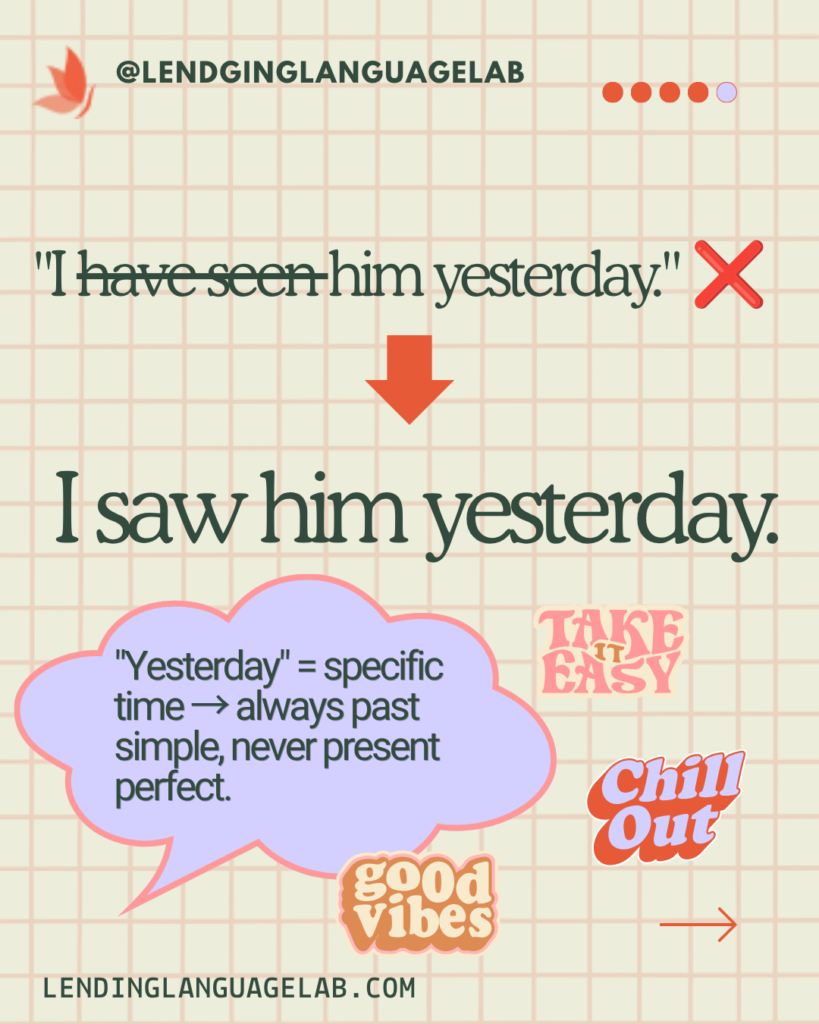
“I have seen him yesterday.”
This is the single most common error I correct, across nearly every level of learner. “Yesterday” is a specific time marker, and present perfect can never be paired with one. The moment you name a specific time, you’re required to switch to past simple: I saw him yesterday.
The reverse mistake happens too; using past simple when there’s no specific time and the sentence is really about a life experience: “I never went to Japan” often should be “I have never been to Japan,” especially when you’re talking about your life up to now rather than one closed period.
Quick Check Before You Go…
Fill in the blank with the correct tense:
She ______ (visit) three countries so far this year..
…
Answer: has visited (present perfect ⪼ “so far” signals an ongoing, unfinished time frame, no specific date given).
Did you get it correct? Let us know in the comments.
If you’ve been secretly avoiding these two tenses so you don’t mess up, you can stop stressing. You’ve got the tools to handle them now.
And hey, if you missed it last month, I covered “there, their, and they’re” (a group that is easily mixed up in English) in the previous post.
This post is the first in a small series on confusing tense pairs; next up is past simple vs. past continuous, so keep your eyes peeled. See you in the next one. ⋆。‧˚ʚ🩷ɞ˚‧。⋆
Discover more from Lending Language Lab
Subscribe to get the latest posts sent to your email.