Let’s be honest: mixing up these three words happens to the best of us.
You’ve probably been racking your brain trying to figure out what the difference is between there, their, and they’re. Well, it’s not that their definitions overlap or that they’re conceptually difficult. They are entirely different! The real trap is that all three words sound 100% identical when spoken out loud. Your ear gives you zero help here, which means your brain has to catch them by sight every single time.
Let’s break them down properly so you never have to second-guess yourself again.
The Three, Side by Side
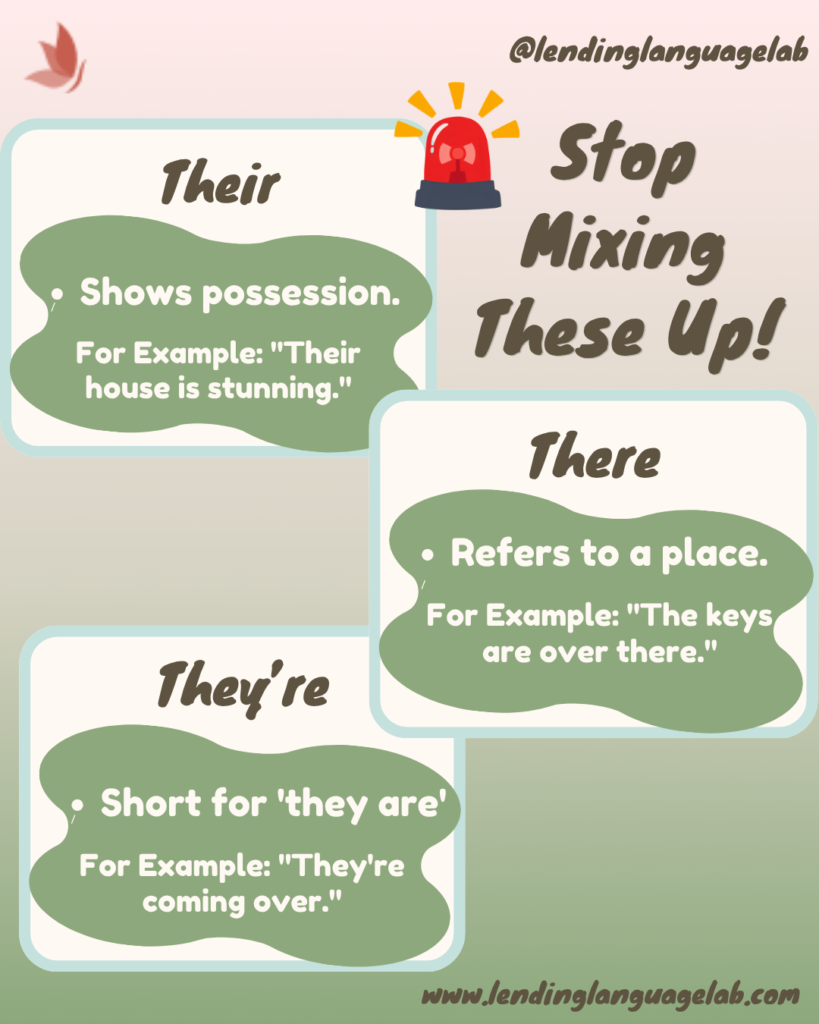
- Their = Shows possession
- This means that something belongs to ‘them.’
- For Example: “Their house is absolutely stunning.”
- This means that something belongs to ‘them.’
- There = Refers to a place, or is used to introduce a sentence.
- For Example: “The keys are sitting right over there.” or “There is no easy answer to this problem.”
- They’re = A contraction short for “they are.”
- For Example: “They’re coming over for dinner tonight.”
Tricks That Actually Work
You don’t need a boring grammar textbook to keep these straight. Use these mental shortcuts instead:
- For their: Look closely at the spelling.
- The word “heir” is hiding right inside it (t-h-eir). An heir is someone who inherits property or belongings. Think inheritance, think possession. Boom, memory hook locked in.
- For they’re: This is the ultimate foolproof test. Mentally expand the word back out to “they are” and read it aloud in your sentence.
- If it still makes grammatical sense, you’re good to go!
- Example: They’re going to the store ➟ They are going to the store. ✅ (Makes sense!)
- Example: Their going to the store ➟ Them are going to the store. ❌ (Total nonsense.)
- Pro Tip: That single swap test will save you roughly 90% of your writing headaches. Trust me, it works every time.
- If it still makes grammatical sense, you’re good to go!
- For there: This is your leftover option. If it doesn’t show ownership and it’s not a hidden “they are,” it’s almost always about location or existence.
- Plus, here is a bonus trick: the word “here” is hiding inside t-here, and both words are all about location!
The Mistake I See Constantly
“Their going to the store” or “Are you coming over their?”
Both are wrong, both show up everywhere, and both are totally fixable in about two seconds using the “they are” test we just talked about. Try reading your sentence back with “they are” swapped in before you hit send on that email or text; the error becomes obvious almost instantly.
Quick Check Before You Go
Let’s test it out. Fill in the blank for this one:
I heard ______ moving to a new apartment next month.
Answer: They’re (short for “they are moving”)
Did you get it correct? Let us know in the comments.
Now if you’ve been quietly sweating bullets or side-stepping these words in your professional emails and quick texts, you don’t have to anymore.
And hey, if you missed it last month, I covered “affect vs. effect” (the reigning champion of most-Googled word mix-ups in English) in the previous post. Go check that out if you need a refresher, and keep your eyes peeled because we have one more pair coming up next month!
Discover more from Lending Language Lab
Subscribe to get the latest posts sent to your email.