Affect vs. Effect, is searched over a million times a month in the U.S. alone. Not “how to use a semicolon.” Not some obscure grammar rule. This one, single word pair. So if you’re like the rest of us and have typed one, deleted it, typed the other, and still weren’t sure… congratulations, you’re in good company.
Let’s put that confusion to rest today, for good.
The Short Version…
Affect is almost always a verb. Effect is almost always a noun.
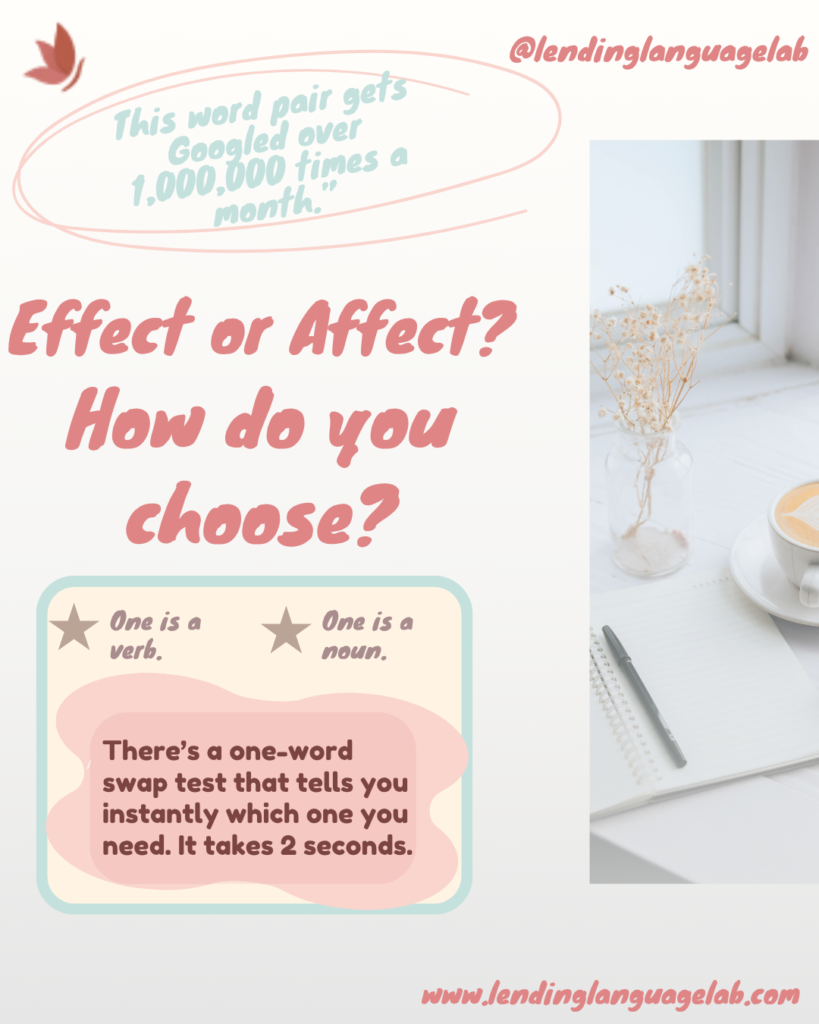
Affect = to influence something.
- For example: The storm affected our travel plans.
Effect = the result of something.
- For example: The storm had a serious effect on our travel plans.
See the pattern?
Affect is the action happening.
Effect is the outcome left behind.
My favorite way to tell the difference is to think: Affect = Action. Both start with an A, and both are about something actively happening.
A Test You Can Actually Use…
If you’re mid-sentence and blanking, try this:
Can you swap the word for “influence” and have the sentence still make sense?
If you can, use affect.
Can you swap it for “result” or “outcome” instead?
Then use effect.
Let’s Take Look at an Example:
- The lighting really affects (influences) my mood.
- The lighting has a big effect (result or outcome) on my mood.
Now to check if we are using the right one we can switch it.
- The lighting really result (effect) my mood.
- The lighting has a big influences (affect) on my mood.
See, the sentence doesn’t make sense when you read it back. That’s the whole trick really… simple and easy to rememeber.
The Exceptions (because English never makes it that easy)
Now it wouldn’t be an English lesson without a couple of exceptions.
“Effect” can occasionally work as a verb, as in “to effect change,” meaning to bring something about. “Affect” also shows up as a noun in psychology, by describing someone’s outward emotional expression.
Unless you’re drafting legislation or writing a psychology paper, you can safely ignore both of these and stick to the verb/noun rule above. It’ll be right majority of the time.
One Last Thing…
I’ve seen this particular mistake constantly:
“The medication had a big affect on me.”
Read that sentence again… that’s a noun spot (a thing the medication had), so it needs to be effect instead of affect.
✅The Correct Version:
“The medication had a big effect on me.”
This is the most common version of this mistake I’ve seen, in emails, essays, even in professional writing. I’ve made this mistake plenty of times myself. But, once you start looking for it, you’ll notice it everywhere.
Check Your Knowledge
Fill in the blank (no peeking at the answer):
The new manager’s leadership style had a noticeable ___________ on team morale.
…
Answer: effect (it’s the result – a noun).
If this one finally clicked, save this post so it’s there the next time you hesitate, and if you want, stick around there are many more confusing pairs for us to breakdown together. Let us know in the comments what word pairs confuse you the most. It just might be our next post.
Discover more from Lending Language Lab
Subscribe to get the latest posts sent to your email.